Archaeological research
Archaeological work was conducted in Lyrbe in the years 1972-1979, by a team led by professor Jale İnan. Since then, unfortunately, no new research has been undertaken. An interesting finding related to Lyrbe was the identification of ancient inscriptions in Side language, specific to this area. Their content suggests that Lyrbe was inhabited by the people of the same origin as the inhabitants of Side on the coast.
Sightseeing
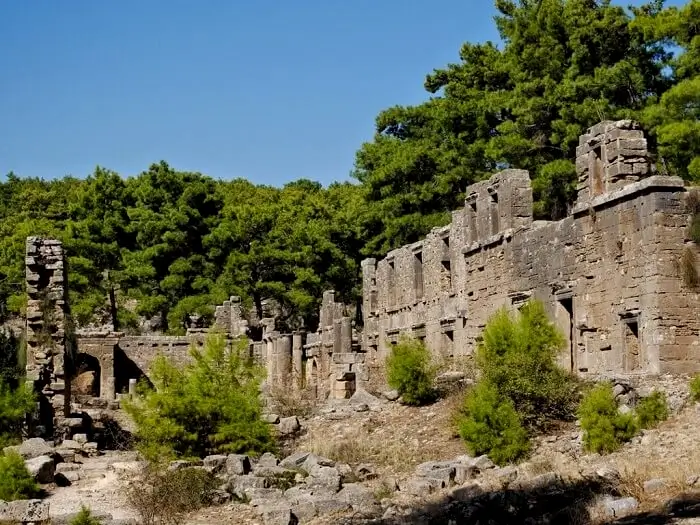
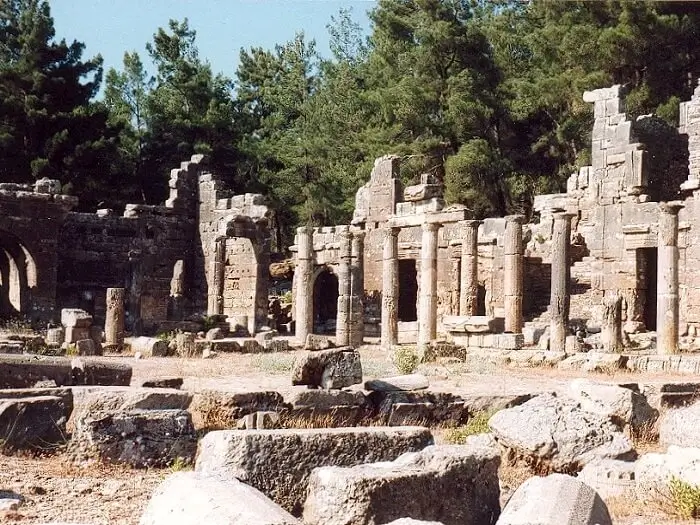
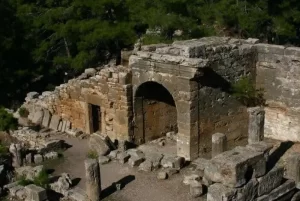
The visible remains of buildings in Lyrbe come from the Hellenistic, Roman and Byzantine periods. The most magnificent building in the city is the agora, considered the best preserved structure of this kind in Pamphylia. In addition, there are remnants of Lyrbe ramparts, baths, temples, cisterns, tombs and a church.
Agora – the political and commercial center of Lyrbe – is a rectangular square, which once was surrounded on all sides by colonnaded galleries in Doric and Ionic orders, and two-storied buildings. Originally, six gates led into the agora. The complex was built in Hellenistic times, in the 2nd century BC and later rebuilt twice – in the early Roman period and the 4tn or 5th century AD.
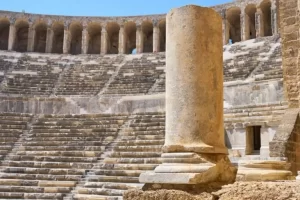
On the northern side of the agora was a library and an exedra – an open niche in the shape of a crescent which was used to conduct political debates. The eastern side of the agora was dominated by an odeon, in ancient times furnished with wooden benches. Next to the odeon a row of shops stretches on this side of the agora.
In the north-western corner of the agora there are the traces of the early Byzantine chapel. Many of the rooms at the agora were adorned with mosaic floors. Two beautiful specimens of such mosaics, depicting the Seven Sages of Greece and Orpheus, are now exhibited in the Archaeological Museum in Antalya.
Other structures in Lyrbe are located next to the agora and on the slope of a mountain above this square. Thanks to its specific location – far from the coast and up in the mountains, Lyrbe has not fallen victim to predatory acquisition of construction materials. Among the lush forest various ancient structures – churches, temples, residential houses, as well as fallen columns and forgotten quern-stones – can be traced in different stages of preservation.